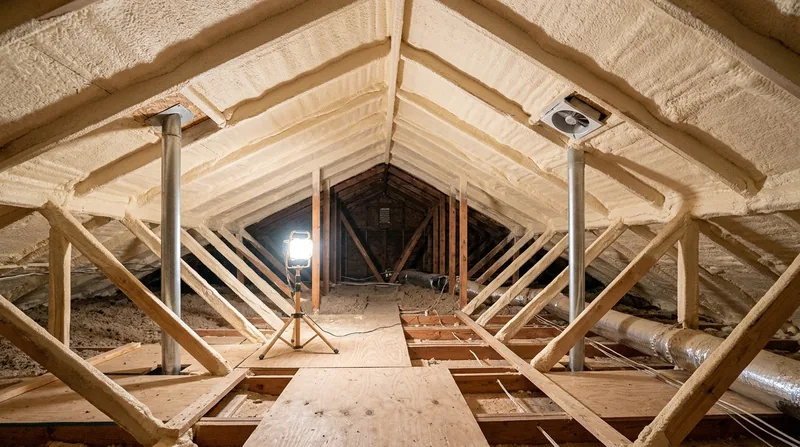




Insulation Replacement & Re-Insulation in Brownsville is not a luxury, it is a survival measure in a climate where your attic temperature can climb past 160 degrees Fahrenheit and stay there for six months straight. Brownsville sits at the southern tip of the Rio Grande Valley in climate zone 2A, where the cooling season runs nearly year-round and humidity never really lets up. Older mid-century block and frame homes near downtown often carry attics that were never built for today's thermal load, while newer two-story stock spreading toward Los Fresnos brings long duct runs through vented attic space that pulls in hot, damp air and works against your air conditioning system. When insulation fails, sags, or was never adequate to begin with, your energy bills climb and your home stays uncomfortable. We remove failed insulation and install new spray foam or blown-in insulation matched to your home's age and the zone 2A climate, restoring the thermal barrier your cooling system depends on.
Why Insulation Replacement & Re-Insulation Matters in Brownsville's Hot, Humid Climate
Brownsville's attics face a unique challenge: moisture drives inward year-round, and vented attics pull in hot, damp air that works against the insulation sitting at the ceiling line and the ductwork running through the space. Fiberglass batts and blown-in cellulose settle, compress, and lose R-value over time, especially in humid conditions. Failed or undersized insulation forces your air conditioning system to run longer and harder, driving up cooling costs across a nine-month season and shortening equipment life. The moment you notice your energy bills climbing or your upstairs rooms staying warm even with the AC running, your insulation is likely the culprit.
- Inspect your attic for settled, compressed, or visibly deteriorated insulation before summer cooling demand peaks.
- Check ductwork for leaks and gaps, which compound the effect of weak insulation and waste conditioned air.
- Ask your contractor for written R-value and thickness specifications so you know exactly what you are paying for.
- Plan replacement during the mild winter months (December through February) when crews are less booked and your home's cooling load is lowest.
A proper insulation replacement job addresses both the insulation itself and the air sealing around it, stopping the hot, humid air from bypassing your thermal barrier.
Key info: Brownsville attics pull in moisture-laden air from the outside because vented attics create pressure imbalances. Sealed attics with spray foam eliminate that pathway entirely, which is why closed-cell foam is the signature job for the Rio Grande Valley's humidity. If you are replacing failed fiberglass or cellulose, ask whether a sealed attic makes sense for your home's age and your cooling bills.
For more on how spray foam seals your attic and stops air leakage, see our attic spray foam insulation service page. You can also review our air sealing services to understand how we seal gaps around ductwork, rim joists, and penetrations that fiberglass never touches.
How We Remove and Replace Insulation in Brownsville Homes
Insulation replacement starts with removal. We use a truck-mounted vacuum system to extract old fiberglass batts, blown-in cellulose, or failed spray foam, capturing dust and debris so your home stays clean. Once the attic is bare, we inspect the substrate for moisture, leaks, or contamination. If we find active moisture, we stop and walk away until the source is fixed. Then we install new insulation, either spray foam sealed across the roof deck (for a conditioned attic) or blown-in insulation at the ceiling line (for a vented attic). Every job gets a written estimate with R-value and thickness so you know what you are getting.
- We vacuum out old insulation with a truck-mounted system, leaving your attic clean and ready for new material.
- We inspect the attic floor, joists, and roof deck for moisture, roof leaks, or contamination before any new insulation goes in.
- We seal air leaks around ductwork, electrical penetrations, and rim joists using spray foam or caulk as appropriate.
- We install new insulation matched to climate zone 2A specifications, with thickness and R-value documented in writing.
- We provide a re-entry window of 24 to 48 hours if spray foam is used, with clear guidance on when your attic is safe to walk in.
The entire process takes one to three days depending on attic size and complexity, and you will see lower cooling bills within your first full month of operation.
Example: A 1,400-square-foot mid-century home in downtown Brownsville with settled fiberglass and visible attic leaks took two days to strip, seal, and re-insulate with 5.5 inches of closed-cell spray foam across the roof deck. The homeowner's cooling bills dropped 18 percent in the first summer. A newer two-story in Los Fresnos with a vented attic and long duct runs had its ceiling insulation topped up with blown-in cellulose and all duct seams sealed, bringing the attic temperature down 12 degrees Fahrenheit and cutting summer cooling costs by 22 percent.
Insulation Replacement Methods and Materials for Brownsville Homes
| Approach | Description | Best for |
|---|---|---|
| Closed-cell spray foam (sealed attic) | High-density foam sprayed across the roof deck, creating a continuous air barrier and moisture barrier. R-value 6.0 to 6.5 per inch, thickness 3.5 to 6 inches typical. | Homes with high cooling loads, ductwork in the attic, or chronic humidity. Most common in Brownsville and the Rio Grande Valley. |
| Open-cell spray foam (sealed attic) | Lower-density foam sprayed across the roof deck, permeable to vapor. R-value 3.5 to 3.8 per inch, thickness 7 to 9 inches typical for zone 2A. | Budget-conscious homeowners, sound dampening, or homes with no ductwork in the attic. Less common in humid climates but suitable if installed correctly. |
| Blown-in cellulose or fiberglass (vented attic) | Loose-fill insulation blown into attic floor cavities over existing insulation or bare joists. R-value 3.2 to 3.8 per inch. Requires proper ventilation and air sealing at rim joists and penetrations. | Simple top-ups of sound attics, budget-friendly replacements, or homes where attic ventilation is already working well. |
| Combination (spray foam rim joists + blown-in ceiling) | Spray foam seals rim joists and band joists at the perimeter, then blown-in insulation covers the attic floor. Combines air sealing with cost control. | Two-story homes in Brownsville and Los Fresnos where rim joist leakage is significant but the ceiling can be blown-in economically. |
Each method has a place. Closed-cell spray foam is the workhorse in Brownsville because it handles humidity and seals the attic completely. Blown-in insulation is sometimes the right answer for a simple top-up of a sound attic. We recommend the method that fits your home, your budget, and your cooling performance goals, not the method that generates the biggest invoice.
Insulation Replacement & Re-Insulation Cost in Brownsville: What to Expect
Insulation replacement costs depend on attic size, the method you choose, the condition of the substrate, and whether you are also sealing air leaks. A typical attic replacement in Brownsville starts at $2,800 for a smaller home with a straightforward job, and climbs from there based on square footage, thickness, and complexity. Spray foam costs more per board foot than blown-in insulation but seals air leaks and stops humidity from entering your attic, which justifies the premium in Brownsville's climate. Removal of failed insulation adds cost but is non-negotiable if you want the new insulation to perform as specified.
- Attic size is the primary cost driver: a 1,000-square-foot attic costs significantly less than a 2,500-square-foot attic.
- Material choice matters: closed-cell spray foam costs more than open-cell foam, which costs more than blown-in cellulose, but each has a different R-value and air-sealing capability.
- Substrate condition affects labor: a clean attic with no contamination is faster and cheaper to insulate than one with old vermiculite, asbestos-wrapped ductwork, or active moisture.
- Air sealing adds cost but saves money on cooling bills: sealing rim joists, ductwork, and electrical penetrations prevents conditioned air from leaking into unconditioned spaces.
- Travel is included in our pricing for Brownsville and surrounding areas, with no separate mileage fee or call-out charge.
The best way to know your actual cost is to request a free estimate with written R-value and thickness specifications. We respond within 24 hours at (956) 382-6207.
Insulation Replacement & Re-Insulation Near Me: What Brownsville Homeowners Should Know When Hiring a Contractor
Finding the right insulation contractor in Brownsville means doing more than picking the lowest bid. The spray foam trade has its rig-and-run crews (out-of-state trailers, a job sprayed in an afternoon, nobody reachable when the smell will not go away) and its national franchises, and the honest local contractor is positioned against both. Ask any contractor for evidence of full insurance coverage, get multiple estimates with written R-value and thickness specs, and check references from recent jobs in your neighborhood. Understand what your city or county requires in terms of contractor registration before work begins, and verify that any contractor you hire can provide proof of compliance.
- Request a written estimate that includes R-value per inch, total thickness, square footage, and a breakdown of labor and materials.
- Ask for proof of full insurance coverage, including general liability and workers compensation, and verify the policy is current.
- Check references from at least two recent jobs in Brownsville, Harlingen, or Los Fresnos, and ask about the contractor's response time if questions arose after the work.
- Confirm what your city or county requires for contractor registration and ask the contractor to provide evidence before work begins.
- Understand the re-entry window if spray foam is used: honest contractors specify 24 to 48 hours and provide clear guidance on ventilation and safety during cure.
- Avoid any estimate with no R-value, no thickness, a price far below market, or a promise of immediate re-entry and no smell.
We are fully insured and have been in business since 2012. We provide written estimates with R-value and thickness specifications, and we stand behind our work. To schedule a free estimate, contact us online or call (956) 382-6207.
Insulation Replacement & Re-Insulation in Brownsville: Pricing Guide
| Service | Price | Details |
|---|---|---|
| Blown-in insulation top-up (vented attic) | Starting at $2,800 | Removal of old material, blown-in cellulose or fiberglass at ceiling line, basic air sealing around penetrations, attics up to 1,200 sq ft |
| Closed-cell spray foam (sealed attic) | Starting at $4,200 | Full removal of existing insulation, closed-cell foam across roof deck at 4 to 5.5 inches, complete air sealing, R-22 to R-30 performance |
| Open-cell spray foam (sealed attic) | Starting at $3,600 | Full removal, open-cell foam at 7 to 9 inches for zone 2A, air sealing, sound dampening, lower cost than closed-cell |
| Combination (spray foam rim joists plus blown-in ceiling) | Starting at $3,400 | Rim and band joist sealing with closed-cell foam, ceiling blown-in with cellulose, cost-effective air sealing for two-story homes |
| Complex or contaminated attic | On estimate | Attics with active moisture, failed foam, or complex geometry require on-site inspection before pricing can be confirmed |
| Estimate and travel | Free | No obligation, written estimate with R-value and thickness specifications, response within 24 hours |
Indicative pricing, the exact cost depends on square footage, finish, and site access. Free personalized estimate within 24h at (956) 382-6207.


