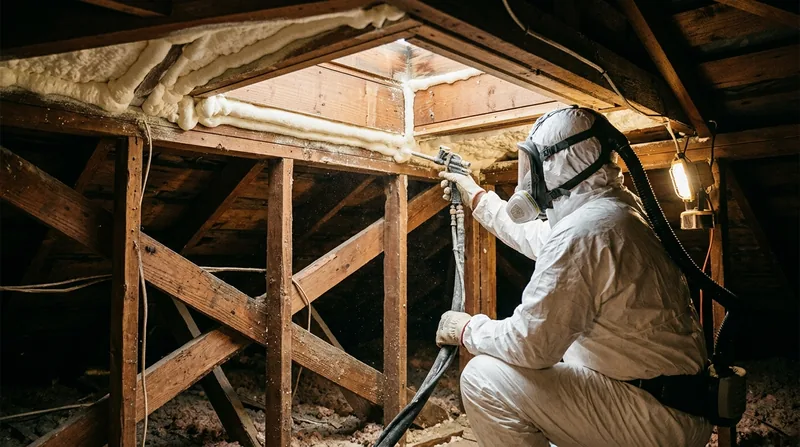




Hot, humid air leaks into Brownsville homes through gaps at the top plate, around ductwork penetrations, and where the attic floor meets the exterior wall. These air sealing points are invisible until you measure them, but they pull outside air into the attic and then into the living space, working directly against your air conditioning through the long cooling season. We find and seal those gaps with foam and sealant, cutting the stack effect and easing the load on cooling. Most Brownsville homes sit on a slab on grade with attics that were never designed for today's cooling demand, and older mid-century block and frame homes carry even more air leakage than newer stock. Sealing the attic boundary is one of the highest-return moves you can make on an energy bill in this climate. Attic spray foam insulation and air sealing work together, but air sealing alone stops the passive stack effect that makes your AC work twice as hard.
Why Air Sealing Matters in Brownsville's Hot, Humid Climate
Brownsville sits in IECC climate zone 2A: hot and humid nearly all year, with hurricane season running June through November and only a brief mild stretch in winter. Humidity never lets up, and that moisture drives inward through every gap in the building envelope. A vented attic full of gaps pulls in hot damp air that works against ductwork running through it and against whatever insulation sits at the ceiling line. Energy bills here track the length of the cooling season more than anything else, and attic air leakage is one of the two biggest culprits, the other being duct leakage in that same vented space. Sealing the attic boundary stops passive air movement and cuts the cooling load.
- We locate air leaks at rim joists, top plates, and around duct penetrations using pressure diagnostics and visual inspection.
- We seal gaps with low-pressure foam, caulk, or a combination of both, depending on the gap width and location.
- We pay special attention to areas where new construction meets old framing, which is common in Brownsville subdivisions built over the past twenty years.
- Sealed attic boundaries reduce the stack effect and lower the temperature of the attic itself, which protects ductwork and reduces cooling runtime.
Air sealing is not a substitute for insulation, but it is the precondition for insulation to work as designed.
Key info: A typical Brownsville home with a vented attic and no air sealing loses conditioned air through the attic boundary every time the inside pressure rises. This passive leakage runs year-round and is invisible until you measure it with a blower door test. Sealing those gaps stops the leakage without requiring a full attic encapsulation.
For more information on how spray foam and air sealing work together in attics, see our closed cell spray foam insulation page, which covers the sealed attic approach in detail.
How We Perform Air Sealing in Brownsville Homes
Air sealing starts with finding the leaks. We walk the attic, inspect the rim joist and band joist where the house meets the foundation, check around ductwork penetrations, and look for gaps where interior walls meet the exterior. We also test with pressure diagnostics to confirm where air is moving. Once we identify the leaks, we choose the right material and technique for each gap.
- We conduct a visual inspection of the attic boundary, rim joist, and all ductwork penetrations to identify air leakage points.
- We use low-pressure foam or caulk to seal gaps, tailoring the material to the gap width and the substrate.
- We pay attention to mechanical penetrations, electrical boxes, and plumbing stacks where air often escapes unnoticed.
- We test pressure and airflow before and after to confirm the sealing is effective.
- We document the work with photographs and notes so you know exactly where the gaps were and how they were sealed.
The work is straightforward, but the difference in comfort and energy use is immediate.
Local example: A two-story home in Los Fresnos with a vented attic over a garage and bonus room often has long duct runs and multiple penetrations where air escapes. We seal the top plate at the exterior wall, the rim joist where the second floor meets the framing, and all ductwork penetrations. The homeowner reports lower cooling bills and more even temperatures between rooms within weeks.
For a detailed look at how air sealing fits into a larger insulation strategy, visit our attic spray foam insulation page.
Air Sealing Methods and Materials
| Method | Material | Best For |
|---|---|---|
| Low-pressure foam sealing | Polyurethane foam, 1 to 3 inch depth | Gaps at top plates, rim joists, and around large penetrations |
| Caulking | Polyurethane or silicone caulk | Narrow cracks, electrical boxes, and small penetrations |
| Gasket and shim sealing | Foam gaskets, weatherstripping, or rigid foam shims | Attic access hatches, ductwork boots, and irregular gaps |
| Spray foam encapsulation | Closed cell or open cell spray foam | Entire rim joist, band joist, or attic boundary when combined with insulation |
The choice of method depends on gap width, substrate type, and whether you are sealing only or sealing and insulating. We specify the right approach for your home during the free estimate.
Air Sealing Cost in Brownsville: What to Expect
Air sealing in Brownsville typically starts at around $650 and scales with the size of the attic, the number of penetrations, and the accessibility of the rim joist. A single-story slab-on-grade home with a small attic and minimal penetrations may fall at the lower end. A two-story home with a vented attic over a garage, bonus room, and long ductwork runs will cost more because there are more linear feet of top plate to seal and more penetrations to address. Older mid-century block and frame homes sometimes have settled framing and irregular gaps that take longer to seal properly.
Several factors affect the final cost. The square footage of the attic boundary is the primary driver, followed by the number and size of penetrations. Access to the rim joist (whether it is exposed or blocked by siding or trim) also matters. If you are sealing only and not insulating, the cost is lower than a combined job. If you are removing old insulation first, that adds labor. We always provide a written estimate that specifies the scope, the materials we will use, and the R-value or thickness of any foam applied. Getting 2 to 3 estimates from different contractors is a smart move because air sealing can be quoted very differently depending on method and material choice.
For a full breakdown of our pricing across all services, visit our pricing page.
What to Look for When Hiring an Air Sealing Contractor Near Brownsville
Hiring the right contractor for air sealing is about verifying three things: insurance, method, and references. The spray foam and insulation trade has rig-and-run crews who show up, spray an attic in an afternoon, and disappear when the chemical smell will not go away. It also has national franchises that use one-size-fits-all foam thickness and do not test or verify results. A local independent contractor with a local address and local plates is the safest bet, but you need to verify that contractor's credentials and work quality.
Before you book, ask any contractor for proof of current insurance. In Texas, contractor registration and licensing are set at the city or county level, not the state level, so requirements vary depending on where you live. Ask your contractor which city or county registration or license applies to your address and request proof of it before work begins. Never accept a verbal assurance. Ask for references from three recent jobs in Brownsville, Harlingen, San Benito, or Los Fresnos, and call them. A good contractor will provide names and phone numbers without hesitation. Ask the contractor to explain their method: How do they find leaks? What material are they using? What thickness or density of foam? How will they verify the job is complete? A contractor who gives vague answers or promises immediate re-entry is not the one to hire. Get a written estimate that includes R-value, thickness, and material type. If the estimate is a single number with no breakdown, walk away.
For a free, no-obligation estimate from a local contractor, contact us at (956) 382-6207. We will walk your attic, explain what we find, and provide a written estimate with full specifications before any work begins.
Air Sealing in Brownsville: Pricing Guide
| Service | Price | Details |
|---|---|---|
| Small attic air sealing | Starting at $650 | Single-story slab home with small attic, minimal penetrations, accessible rim joist, foam and caulk sealing |
| Medium attic air sealing | Starting at $1,200 | Two-story home, vented attic, multiple penetrations, ductwork boots, partial rim joist exposure, foam and caulk |
| Large or complex air sealing | On estimate | Bonus rooms, long duct runs, extensive rim joist sealing, older framing with irregular gaps, requires on-site inspection |
| Air sealing plus insulation | On estimate | Sealing combined with spray foam insulation, attic encapsulation, or rim joist encapsulation, larger scope and material cost |
| Travel | Included | No separate mileage or travel fee within Brownsville, Harlingen, San Benito, Los Fresnos, and surrounding areas |
| Free estimate | Free | Written estimate with specifications, no obligation to book, response within 24 hours at (956) 382-6207 |
Indicative pricing, the exact cost depends on square footage, finish, and site access. Free personalized estimate within 24h at (956) 382-6207.


