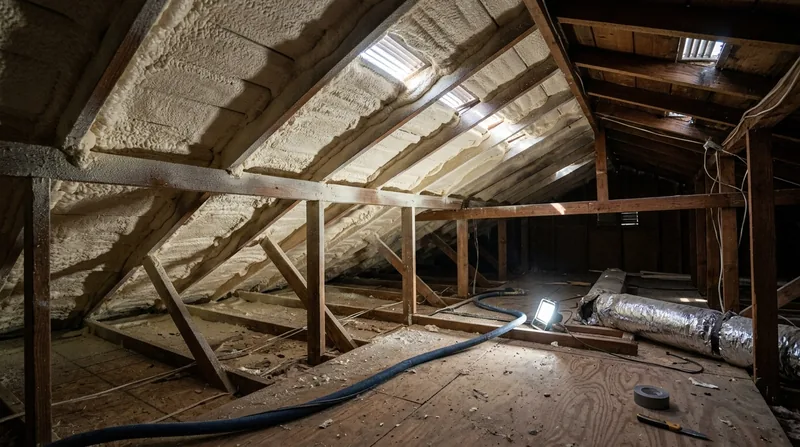




Attic spray foam insulation in Brownsville seals the roof deck against the heat and humidity that dominates climate zone 2A nearly year-round. Brownsville sits at the southern tip of the Rio Grande Valley, where most homes rest on a slab and older block-and-frame houses near downtown carry attics that were never engineered for today's cooling loads. Newer two-story subdivisions pushing toward Los Fresnos and across the north side bring bonus rooms over garages, with long duct runs buried in vented attic space that pulls in hot, damp air from June through November and beyond. That moisture load works directly against your air conditioning, shortens equipment life, and drives energy bills higher every month the cooling season runs. We seal the roof deck with spray foam to cut that moisture infiltration, protect ductwork, and hold indoor temperature steady without fighting the outside air.
Why Attic Spray Foam Insulation Matters in Brownsville's Hot, Humid Climate
Vented attics in Brownsville pull in outside air through soffit vents, and that air is hot and humid nearly all year. The temperature difference between the attic and the conditioned space below drives air infiltration through every ceiling gap, light fixture, and duct connection. Sealed roof deck spray foam stops that moisture load at the source, dropping the attic temperature and protecting the ductwork that runs through it. A single-story home near downtown with ductwork in a vented attic can see attic temperatures exceed 150 degrees in summer, forcing the air conditioning to work harder and longer. Spray foam fixes that.
- We seal the roof deck with closed-cell or open-cell foam to eliminate hot air infiltration through the ceiling plane.
- The foam creates an air barrier that stops moisture from entering the attic, protecting insulation and ductwork from humidity damage.
- Sealed attics lower the temperature difference between inside and outside, reducing the run time and load on air conditioning equipment.
- Ductwork sealed and buried in foam stays cooler and loses less conditioned air to leakage, improving system efficiency.
In Brownsville's climate, a sealed attic is not optional for homes with ductwork overhead; it is the single most effective upgrade for cooling efficiency and equipment longevity.
Key info: A mid-century block home in downtown Brownsville with a vented attic and ductwork running across the ceiling can see attic temperatures climb to 140 to 160 degrees in July and August. Sealed with closed-cell foam, that same attic stabilizes at 95 to 110 degrees, cutting the cooling load by 30 to 40 percent on peak days. Homeowners in Harlingen and San Benito report similar gains.
For more on how foam protects ductwork specifically, see our guide to closed-cell spray foam insulation, which is the standard choice for sealed attics in humid climates.
How We Seal and Insulate Your Attic in Brownsville
Attic spray foam sealing starts with a walk-through to locate all ceiling penetrations, duct leaks, and areas where outside air enters the conditioned space. We remove any damaged or failed insulation, seal rim board and band joist areas if accessible from above, and then spray the roof deck with foam at the specified thickness to achieve the R-value your home needs. The process takes one to two days depending on attic size and complexity. We provide mechanical ventilation during cure and a re-entry window of 24 to 48 hours before the space is fully occupied again.
- We inspect the attic for air leaks, duct connections, and existing insulation condition before proposing a scope.
- All ceiling penetrations are sealed with foam or caulk to eliminate pathways for hot air and moisture to enter the conditioned space.
- We spray the roof deck at the thickness and R-value specified in our written estimate, using the correct foam type and ratio for Brownsville's climate.
- Mechanical ventilation runs during cure, and we confirm re-entry timing with you before leaving the job site.
- Once cured, the foam is covered with an ignition barrier and thermal barrier as required by the building code in your city.
The result is a sealed attic that stays cool, dry, and protected from the outside moisture load that dominates the Rio Grande Valley climate.
Example: A two-story home in Los Fresnos with a bonus room over a garage and 800 linear feet of ductwork in the attic receives a sealed roof deck with 5.5 inches of closed-cell foam, achieving R-38. The job takes one full day, mechanical ventilation runs overnight, and the homeowner can return to normal use on day two. The ductwork is now fully protected from the outside humidity and temperature swings that were causing condensation and energy loss.
If your attic also needs air sealing around penetrations and rim board areas, we handle that as part of the overall foam scope.
Attic Spray Foam Methods and Approaches
| Approach | Description | Best for |
|---|---|---|
| Sealed Roof Deck with Closed-Cell Foam | Spray closed-cell foam directly on the underside of the roof sheathing, creating an air and moisture barrier. Typical thickness 4 to 6 inches, R-24 to R-36. | Homes with ductwork in the attic, high humidity climates, and secondary cooling or bonus rooms that require maximum thermal control. |
| Sealed Roof Deck with Open-Cell Foam | Spray open-cell foam on the roof deck for a lower-cost air barrier with good sound dampening. Less vapor-resistant than closed-cell; requires a separate vapor barrier in humid climates. | Budget-conscious retrofits where noise reduction is a secondary goal and the roof deck is in good condition with no active leaks. |
| Top-Up Foam Over Existing Insulation | Spray a layer of foam over sound fiberglass batts or blown-in insulation to seal gaps and air leaks without full removal. Typical thickness 1.5 to 3 inches. | Attics with adequate insulation depth but poor air sealing, or where removal cost is a constraint and the existing material is dry and undamaged. |
| Full Insulation Removal and Sealed Replacement | Remove all old, damaged, or failed insulation, air-seal the roof deck and all penetrations, then spray closed-cell or open-cell foam. Achieves the highest R-value and air barrier integrity. | Attics with failed foam, moisture damage, settled or compressed insulation, or where a complete thermal and air barrier upgrade is the long-term goal. |
Attic Spray Foam Insulation Cost in Brownsville: What to Expect
Attic spray foam insulation in Brownsville typically starts at $1.50 to $2.50 per square foot for a sealed roof deck with closed-cell foam at R-24 to R-30. The final cost depends on attic size, foam type, thickness required to meet your R-value target, and whether existing insulation must be removed first. Access, ductwork complexity, and the number of ceiling penetrations that need sealing also affect the total. A 1,200-square-foot attic with moderate access and no removal might run $1,800 to $3,000; a larger or more complex job requiring full removal could exceed $4,500. We provide a written estimate that specifies R-value, thickness, and total cost before any work begins. Get full pricing details and request a free estimate by calling (956) 382-6207 or visiting our contact page to speak with a spray foam specialist about your specific attic.
Open-cell foam runs lower, typically $1.00 to $1.75 per square foot, but requires a separate vapor barrier in Brownsville's humid climate and is best suited to attics without ductwork. If your attic already has sound fiberglass insulation and you need only air sealing and a top-up layer, a partial foam application may cost $800 to $1,500 and is sometimes the right answer. We never quote a price without a site visit and a clear understanding of what you are trying to achieve.
What to Look for When Hiring an Attic Spray Foam Insulation Contractor Near Brownsville
Spray foam installation is not licensed at the state level in Texas, but your city or county may require contractor registration or a permit before work begins. Always ask any contractor for proof of the registration their municipality requires and verify it with your local building department before signing a contract. Confirm that the contractor is fully insured and can provide a certificate of insurance naming you as an additional insured. Request a written estimate that specifies the foam type, thickness in inches, R-value, total square footage, and labor and material costs broken out separately. A low-ball price with no R-value stated and no mechanical ventilation plan during cure is a red flag.
- Get at least two or three written estimates before choosing a contractor, and compare R-value and thickness specifications, not just price.
- Ask the contractor how they handle mechanical ventilation during cure and what re-entry window they guarantee before normal use resumes.
- Request references from recent attic jobs in Brownsville, Harlingen, or San Benito, and call them to ask about odor, timeline, and whether the contractor was reachable after the job was done.
- Confirm that the contractor will seal all ceiling penetrations, duct connections, and rim board areas as part of the scope, not as an upsell.
- Verify that the foam will be covered with an ignition barrier and thermal barrier per the building code in your city; never accept an estimate that skips this step.
A local, independent spray foam contractor with a physical address and local plates is accountable to your city and your neighbors in ways that a rig-and-run crew or a national franchise may not be. Ask us any questions about our process, our insurance, or our past work; we will answer them directly and honestly. Call us at (956) 382-6207 to request a free estimate and speak with a spray foam specialist who knows Brownsville attics.
Attic Spray Foam Insulation in Brownsville: Pricing Guide
| Service | Price | Details |
|---|---|---|
| Sealed Roof Deck, Closed-Cell Foam, R-24 to R-30 | Starting at $1.50/sq ft | Includes roof deck spray, all ceiling penetration sealing, ignition and thermal barriers, mechanical ventilation during cure |
| Sealed Roof Deck, Open-Cell Foam, R-18 to R-24 | Starting at $1.00/sq ft | Lower cost option for attics without ductwork; requires separate vapor barrier in Brownsville's humid climate |
| Full Insulation Removal and Sealed Replacement | On estimate | Removal cost plus foam spray; total depends on attic size, existing insulation type, and debris disposal complexity |
| Top-Up Foam Over Existing Insulation | Starting at $0.75/sq ft | Partial foam layer for air sealing and R-value boost; best when existing insulation is sound and removal is not needed |
| Travel and Mobilization | Included | No separate mileage fee or travel charge in Brownsville and surrounding Rio Grande Valley service areas |
| Free Written Estimate | No charge | Response within 24 hours; includes R-value, thickness, square footage, and total cost; no obligation to book |
Indicative pricing, the exact cost depends on square footage, finish, and site access. Free personalized estimate within 24h at (956) 382-6207.


